
Bwindi Impenetrable National Park
The Home of Gorillas in Africa
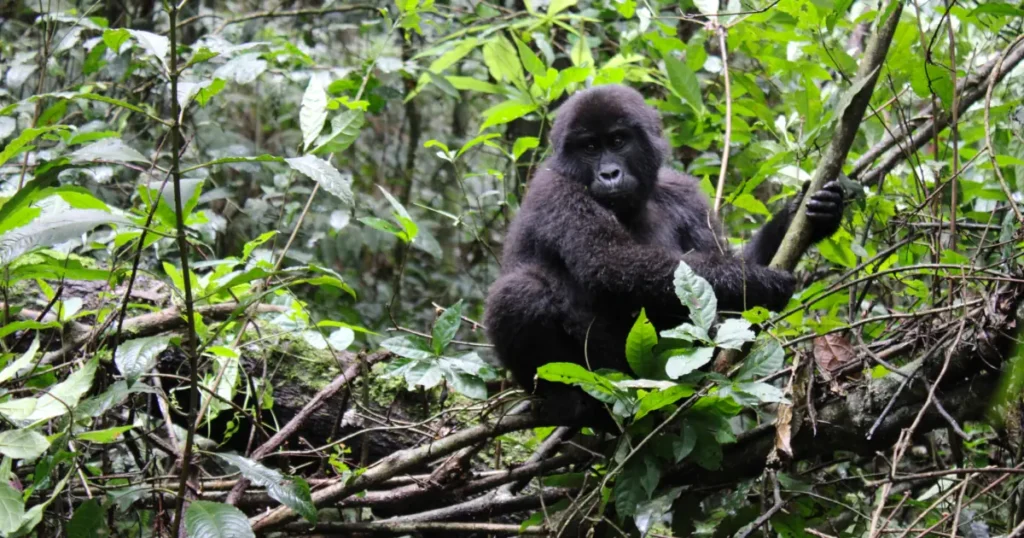
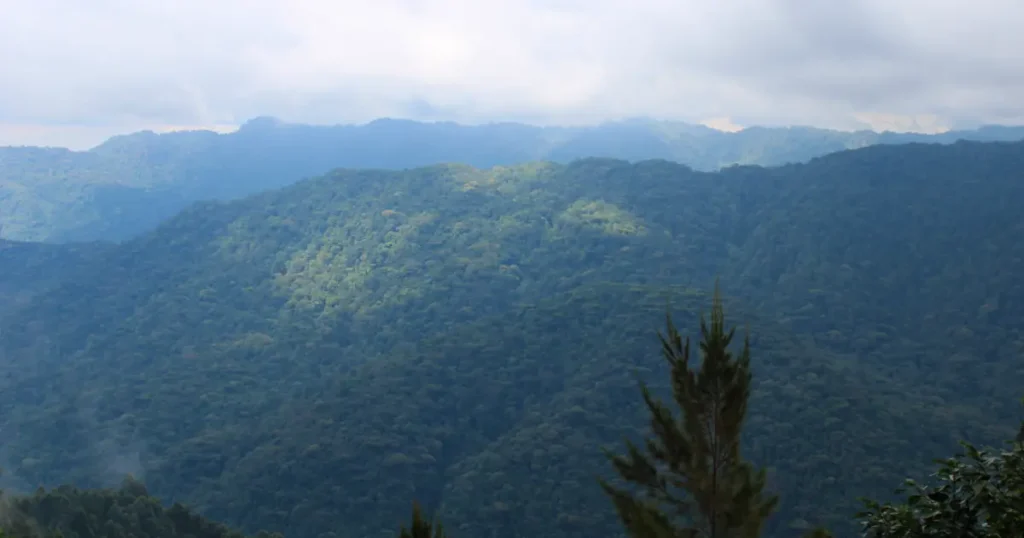
Wonders of Uganda never stop. Bwindi Impenetrable National Park is a unique and amazing old-growth forest perfect for gorilla trekking. The lush forest blends seamlessly with the sounds of native birds and the calls of mountain gorillas. The amazing misty virgin forest is made up of steep hills and narrow valleys.
Where is Bwindi located?
The national park is in southwestern Uganda, East Africa. Its coordinates are -1.080556, 29.661389.
The Bwindi area covers the districts of Kisoro, Rubanda, and Kanungu in Uganda. To the west of the forest is a small region bordering the Democratic Republic of Congo known as Sarambwe. Virunga in the DRC is next to Uganda’s gorilla park.
How to get to Bwindi Forest National Park?
Reaching the renowned gorilla forest is by road or by air. Many visitors who have enough time like to travel by road. They enjoy the beautiful scenery and attractions along the way. Chartered and scheduled flights are available from Entebbe Airport to Bwindi.
Uganda’s love for the Forest.
Bwindi Forest hosts many species. Visitors from around the world and local communities love this lush forest.
The Ugandan government has prioritized natural resource conservation. With Uganda’s proactive stance. Various international agencies funded a “Forestry Rehabilitation Project” that lasted six years.
This project started in 1989. The government launched it to create national parks in Uganda. They also signed the “Convention on Biological Diversity” (CBD).
Gazetting the forest as a national park.
The forest became a natural forest reserve in 1932. It was later named a wildlife sanctuary in 1961.
The year 1991 was a pivotal moment for this Central Forest Reserve. The reserves below changed status to national parks.
- The Rwenzori Mountains Reserve
- Mgahinga Gorilla Reserve
- Impenetrable Central Forest Reserve.
The Central Forest Reserve name changed its name to Bwindi Impenetrable National Park. The Uganda Wildlife Authority (UWA) currently manages the park. It serves as both a forest reserve and a wildlife sanctuary.
Bwindi’s status as a protected national park had both good and bad effects.
It helped protect many plant and animal species. This includes mountain gorillas and special bird species in the Albertine Rift. Gorilla trekking in Bwindi began in 1993 as a tourism activity.
The Batwa pygmies once called the forest home. They relied on it for food, medicine, and other resources. Now, they cannot access the forest without supervision.
Bwindi National Park Biodiversity
This forest covers about 33,100 hectares. It is Uganda’s top park for gorillas. The Bwindi Sarambwe ecosystem includes 900 hectares of the Sarambwe Nature Reserve. This brings the total to about 340 square kilometers.
Biogeographic regions of Africa converge in Uganda. This explains why several species inhabit Uganda’s ecosystems. Uganda is a unique country for research and safaris. Its extraordinary biological diversity includes many endemic species.
Vegetation
The forest has altitudinal terrain that ranges from 1,160 to 2,607 meters above sea level. Different altitudes shape the climate and the plants in a place. Many plants and animals coexist in this forest, from low to high altitudes.
The park is a forest, not a savanna. Most Ugandan national parks are of savanna vegetation (tropical grasslands). The gorilla trekking park has a transitional forest.
Montane and lowland forests make up the vegetation in this park. The park has high-altitude forests and medium-altitude moist evergreen forests. The vegetation includes over 1,000 types of flowering plants.
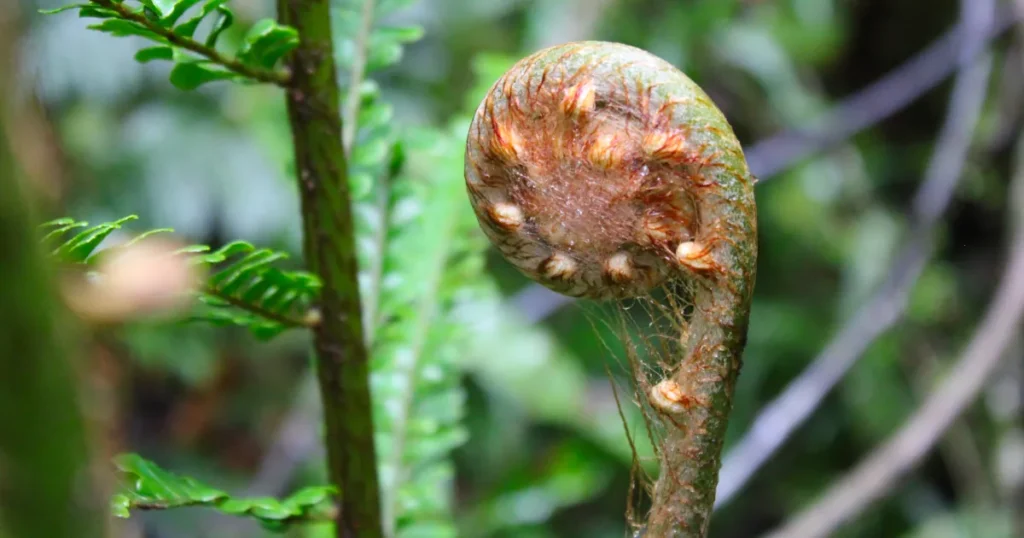
The gorilla forest has a mix of vegetation types. These include herbaceous plants, Mimulopsis, grasslands, meadows, and mixed bamboo. You’ll also find bracken fern, swamps, Neobutonia trees, and mixed forests.
Botanical surveys done in Bwindi Forest National Park list more than 200 tree species. The forest has many tree species. Ten of these tree species are only in Bwindi and southwestern Uganda.
The impassable forest is a key ecological area. It boasts over 38% of Uganda’s tree species. Documented ferns in this forest are around 104 species, and all grow well in this forest.
Bwindi Impenetrable National Park Tree Species
High-altitude forests dominate the entire area. They include:
- Moist montane forest (Pygeum africanum)
- Highland bamboo forest
- Newtonia buchananii at around 2,000 meters.
- Chrysophyllum gorungosanum, which grows at roughly 2,200 meters.
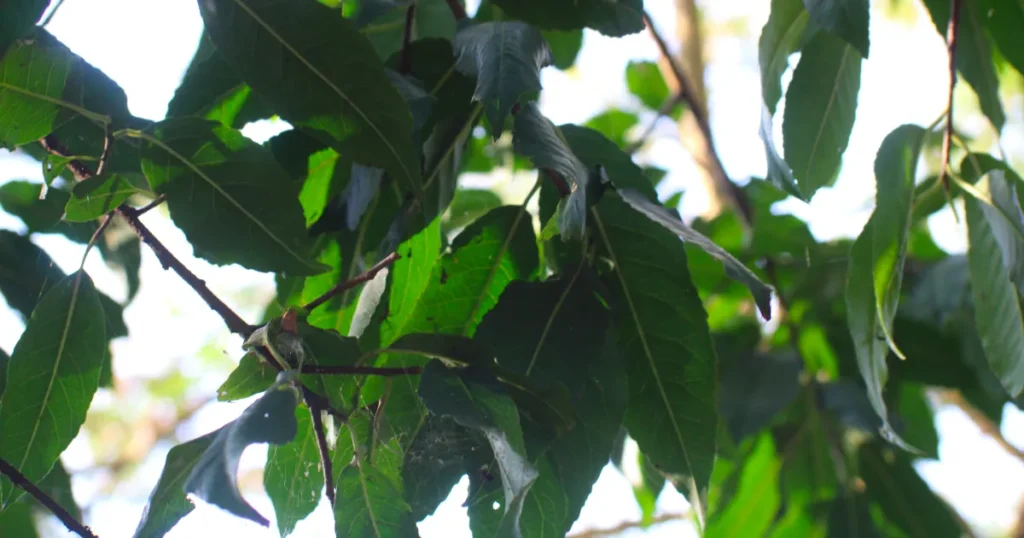
This vast area of evergreen plants provides a steady food source for many animals. Bamboo and the fruits of Prunus africana are part of the mountain gorilla’s diet. Many researchers visit Uganda to study the country’s unique plant species.
Medium altitude moist evergreen forests of Parinari exelsa thrive at 1,500 meters.
Eucalyptus trees planted for demarcation purposes form part of the park’s boundaries. The entire forest vegetation covers 331 square kilometers. This is the park’s total size. Some locals have planted small eucalyptus patches on their farms. This helps them avoid disturbing the park’s trees.
Montane tropical forests in Sub-Saharan Africa have the Prunus africana tree species. Pygeum africanum is native to Africa. In Uganda, the highest count is in Bwindi Forest, Kalinzu Forest, and Mount Elgon.
This species dominates the mountains of Southern and Central Africa. IUCN lists it as Vulnerable. High demand for traditional medicine and global drugs affects these trees. Pygeum is also used for timber, firewood, and charcoal. All these factors call for its conservation.
In 1995, scholars Robert Marchant and David Taylor studied Mubwindi Swamp. This area is a water catchment. It sits 2,100 meters above sea level in the park. Pollen from Prunus africana in Mubwindi Swamp dates back 43,000 years. This means that this species has survived many climate changes.
Palaeobotanical evidence shows that this forest served as a refugium. This was during the Great Ice Age. This epoch started around 2.6 to 1.8 million years ago and ended about 11,500 years ago.
Animals
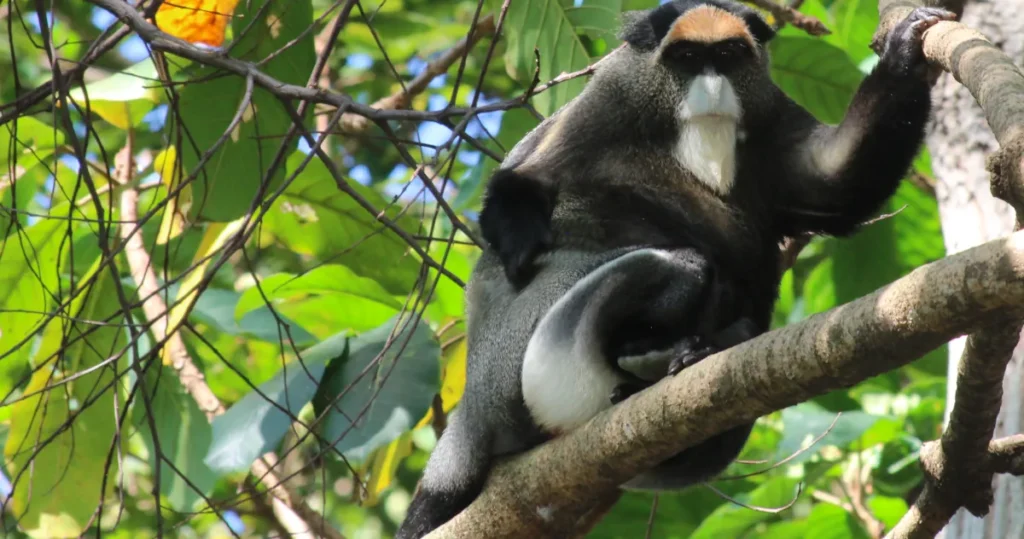
The forest’s unique ecosystem shelters a lot of animals. You can often see mammals, birds, reptiles, amphibians, and fish in this dense forest. Among the animals of this forest, gorillas and birds are the most admired.
Animals in Bwindi Impenetrable National Park.
Uganda, located in East Africa, is home to over 345 mammal species. The forest is hosting over 120 mammal species. This number is one-third of Uganda’s mammals found in forests and savannas.
Mammals of this overgrown forest are both big and small. Primates include:
- mountain gorillas
- chimpanzees
- baboons
- L’Hoest’s monkeys
- blue monkeys
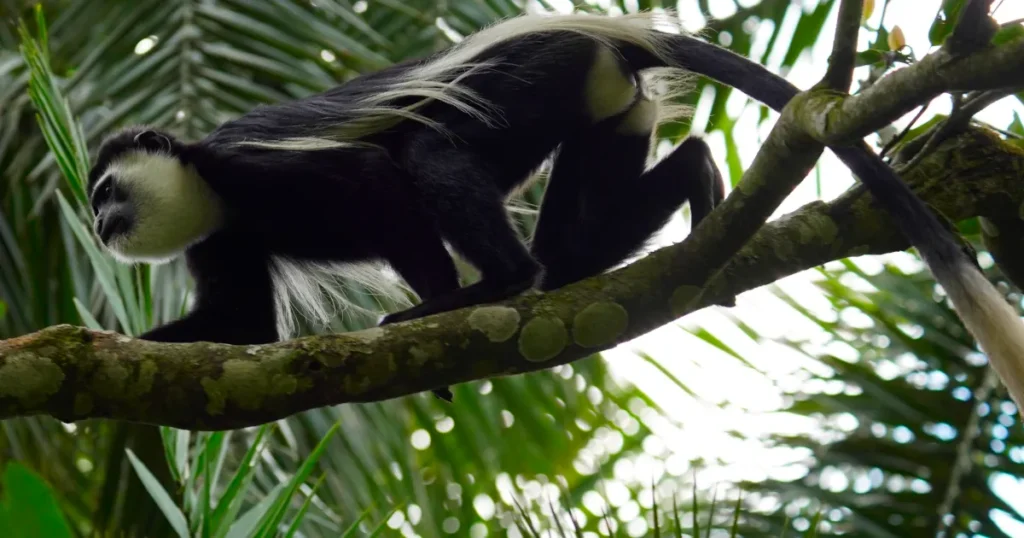
- black-and-white colobus monkeys
- red-tailed monkeys
Bwindi Chimpanzee Population
UWA and partners conducted the first chimpanzee census in Bwindi forest. The chimp census from May to June 2025 revealed a total count of 426 chimpanzees in Bwindi Forest. Please note that chimpanzee trekking in Bwindi is not a dedicated tour activity. You might encounter some chimps in the park’s southern and northern sectors. Kibale Forest is the best place to see chimpanzees in Uganda.
Chimps are hard to spot in this forest. The common mammals in the forest include African elephants, duikers, bushbucks, and bush pigs. You’ll also find sitatungas, jackals, antelopes, rodents, shrews, bats, and many others.
Mountain gorillas of Bwindi Forest National Park
Uganda’s dense forest is known for mountain gorilla conservation. People love great apes because they reveal facts about human evolution. This is why they are our close relatives.
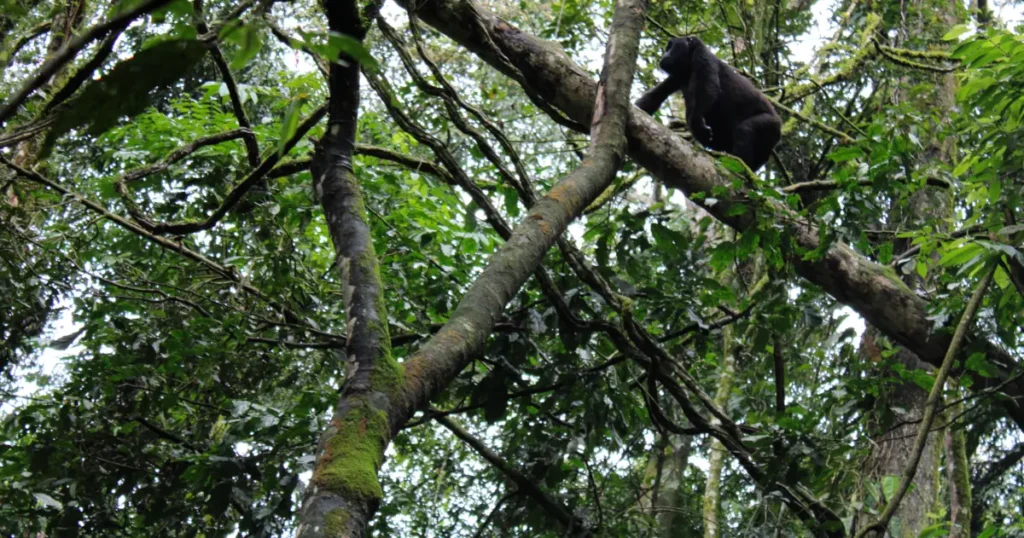
Gorillas in the wild are of two species. They further form four subspecies.
The gorilla species are the Western gorilla and the Eastern gorilla.
Western gorilla subspecies are the Western lowland gorilla and the Cross River gorilla.
The Eastern gorilla is our main focus. It has the rarest subspecies found in Central and East Africa, including Bwindi. There are two eastern gorilla subspecies. They include the Eastern lowland gorilla and the Mountain gorilla.
Birds
Rare bird species have made this world heritage site popular. The forest has over 350 bird species. Twelve bird species are seen only here.
Seventy of the 78 montane forest species found in the Albertine Rift are in Bwindi. Endemic birds of the Albertine Rift are 36, and the forest is home to 22 of these species. The IUCN listed 8 species as threatened. The IUCN threatened category includes Critically Endangered (CE), Endangered (EN), and Vulnerable (VU).
Bwindi Forest is home to a diverse range of montane forest species. It also has unique birds from the Albertine Rift. These include:
- Grauer’s Broadbill (VU)
- Long-tailed Cuckoo
- Scarce Swift
- Rwenzori Turaco
- Grauer’s Swamp-warbler (VU)
- Brown-cheeked Hornbill (VU)
- Grey Parrot (EN)
- Shelley’s Crimsonwing (EN)
- Chapin’s Flycatcher (VU), to mention but a few.
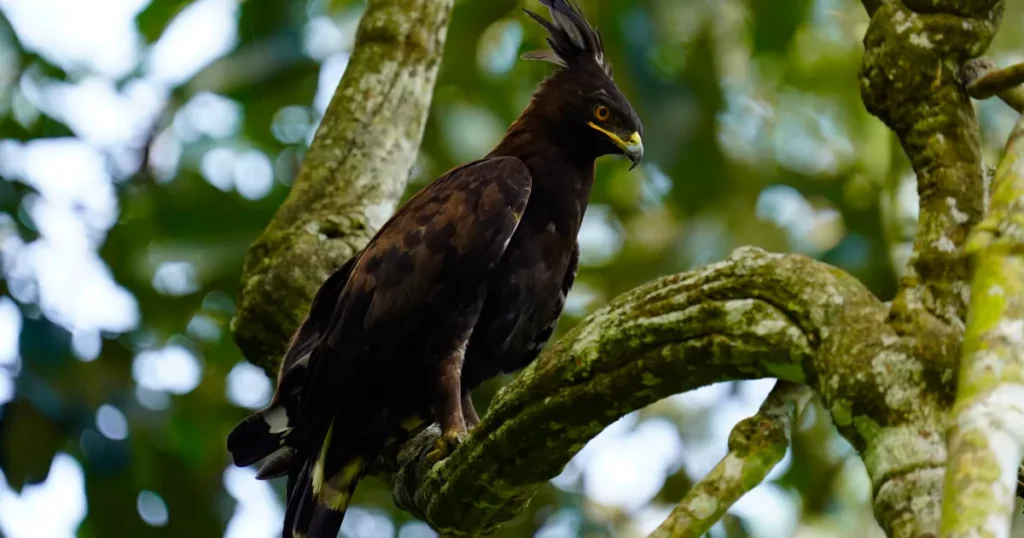
Some bird species in the Albertine Rift are in the eastern DRC lowlands birding area.
Reptiles
The reptiles of this forest are plentiful. They thrive under the dense tree cover. Snakes and some lizards, like the three-horned chameleon, are native to this forest. There are 14 snake species, 9 of which are endemic to this forest. Fourteen lizard species are in this park.
Fish
The fish live in rivers and swamps. Not much information is available about the Bwindi fish species. This is because fishing in the park is not allowed. Some fish found in this forest are riverine cichlids and catfish.
Major swamps include Mumbwindi and Ngoto. Rivers include Ishasha, Ivi, Ihihizo, Munyaga, and Ntengyere.
Amphibians
Amphibians in the world are of three types: Anura, Apoda, and Urodela. The most noteworthy is Anura, which includes frogs and toads. The forest hosts over 27 amphibian species, of which 11 are endemic to the Albertine Rift.
Insects in Bwindi National Park
Insect species that are in the hundreds call this forest a paradise. This conservation area has winged and wingless insects. Vegetation during gorilla trekking is charming. Thanks to spiders, ants, montane forest butterflies, and five species of stingless bees.
Over 220 butterfly species live in the park. Eight butterfly species are endemic to the Albertine Rift. The kite swallowtail and the cream-banded swallowtail species are only found in southwestern Uganda. The cream-banded swallowtail and African giant swallowtail are globally threatened species.
Biodiversity Hotspot
Is Bwindi a part of the Eastern Afromontane biodiversity hotspot?
In 2005, the Albertine Rift Valley was designated a biodiversity hotspot. Bwindi Impenetrable National Park rests at the edge of the Albertine Rift.
This section of the Rift Valley has high biodiversity numbers. Unregulated human activity threatens endangered species. This has led to irreparable losses of flora and fauna. The Old-Growth Forest is in the Eastern Afromontane biodiversity hotspot. It hosts many rare plants and animals.
Conservation Park
Is Bwindi Forest a conservation area?
Uganda’s gorilla forest is a conservation park. The forest is a UNESCO World Heritage Site. The inscription date on the World Heritage list was 17th December 1994.
The Uganda Wildlife Authority manages the park. Conservationists choose Bwindi for the following reasons:
- High biodiversity
- Water retention and catchment area
- Climate stabilizer
- Home of endangered species
- Beautiful natural scenery
- Cultural site, and
- Habitat for most Albertine Rift-endemic species.
Conservationists worldwide formed a team to protect this rich biodiversity. Conservation projects in Bwindi are numerous.
The tropical forest is amidst farmlands. It borders busy rural areas where the Bakiga and Bafumbira people live, along with a few Batwa.
Funds from this wildlife park in Uganda have helped the local communities. That’s why they have a positive attitude towards conservation.
Uganda has enacted several laws in support of biodiversity conservation. This forest has also gained political support. This is due to several regional and international laws that Uganda has signed.
History
What do the words Mubwindi and Bwindi mean?
It originates from a Bantu language spoken by the park’s communities. Bwindi means “a place full of darkness”.
The thick old-growth forest explains the origin of the park’s name. It’s a place filled with shadows and mystery. In the Ruhija sector of Bwindi Impenetrable National Park, you’ll find Mubwindi Swamp. This site is popular for birding and is home to many endemic bird species from the Albertine Rift.
The name of the swamp originates from “Mubwindi bwa Nnyinamukari.” This is a Bwindi community folk tale. It is about the sacrifice of a young woman (“Nnyinamukari”). Her family offered her to the swamp for safe passage. When the community heard of this story. They all lived in fear. Hence, naming the swamp Mubwindi bwa Nnyinamukari (Mubwindi Swamp).
The term “Impenetrable” is due to the park’s dense layers of lush trees, shrubs, and vines in the valleys.
Climate
Bwindi has wet, humid, and hot weather. This is due to its tropical climate. There are two dry seasons and two annual rainy seasons. September through November and March to May are months of heavy rainfall.
The annual temperature ranges from lows of 7 to 15 degrees Celsius. Highs are from 20 to 27 degrees Celsius.
The forest ranges from 1,400 to 1,900 millimeters of rainfall. In wet weather, mist blankets the forest after rain and in the early morning. It fades away when the sun arrives.
Visiting the forest is possible all year round if you have already secured gorilla permits. Choosing what to wear when you go gorilla trekking is also very important.
Gorilla Trekking in Bwindi National Park.
Where are gorillas found in Uganda?
Mountain gorillas live in the thickest forest of Uganda. This article gives the main reasons.
Nature lovers say it is not an accident that apes live in an old evergreen forest like Bwindi. You must mention gorilla trekking when you talk of Bwindi.
People visit this forest to trek and watch gorillas. Tourists from many countries come to see this endangered ape. The mountain gorilla is a key species of the Albertine Rift. Our Uganda safari company can tell you how to visit Bwindi Impenetrable National Park.
Uganda has 19 gorilla groups that visitors can meet. They live in two parks, Bwindi and Mgahinga. A 2018 census counted many gorillas. It found that Uganda protects about 459 mountain gorillas. That is more than half of all mountain gorillas. The others live in Volcanoes National Park in Rwanda and in Virunga National Park in the DRC.
Tourism puts pressure on park staff to make more gorilla groups tolerant of humans. This can make gorillas too used to people. People are a greater danger to gorillas than the wild.
A Uganda safari to see mountain gorillas is a top African safari activity. Booking gorilla permits earlier is the best idea; they are usually scarce.
Where to stay
The Forest offers natural, friendly lodges for gorilla trekking. Bwindi accommodation is for all budgets. Bwindi hotels/lodges are budget, mid-range, and luxury. Meals are at your lodge, depending on your budget option.
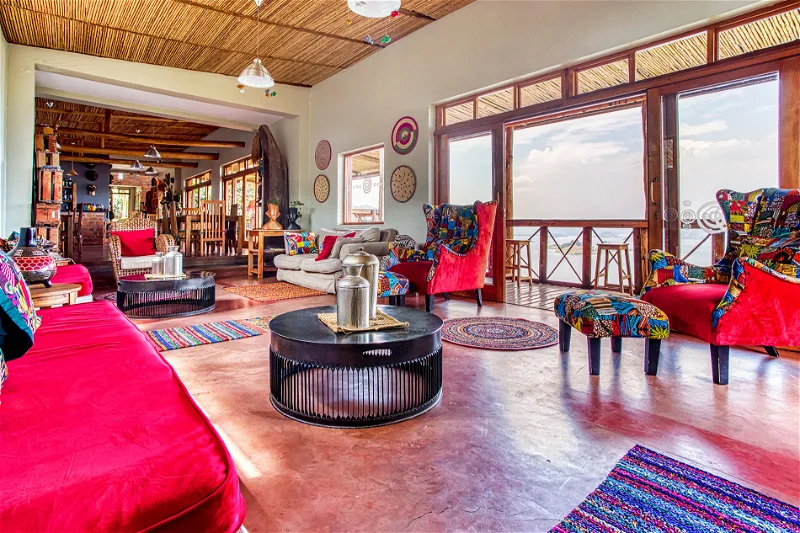
Some of the lodges around the park include:
- Buhoma Lodge
- Silverback Lodge
- Chameleon Hill Lodge
- Clouds Mountain Gorilla Lodge
- Sanctuary Gorilla Forest Camp and many more lodges are on our list of Bwindi accommodations.
Additional activities
Gorilla trekking is the top tourist activity in this forest. Still, other Uganda safari activities continue in or near Bwindi Impenetrable National Park as well. They include
- Golden Monkey Tracking
- Mountain climbing
- Batwa Cultural Visit
- Community Tour
- Canoeing
- Lake Bunyonyi boat trip
- Birding
- Nature walks.
Things to do after Gorilla Trekking in Bwindi Forest
Forest bird-watching is another Uganda safari activity for birders. Birding in this forest is second to gorilla trekking. Threatened species of IUCN categories Endangered and Vulnerable are in this gorilla tracking forest. Buhoma and Ruhija are top bird-watching areas in the park.
Guided nature walks or walking safaris in this natural forest offer a great experience. You’ll see waterfalls, forest animals, and unique plants.
Munyaga River Falls is a charming site in the jungle. A lot of birds and mammals exist along this trail. The Munyaga Waterfall trail has beautiful butterflies and blooming plants. They brighten the thick forest. Kashasha River Trail and Ivy River Trail are other hiking routes that might interest you. These two trails are also very rich in plant and animal species.
A Community visit is interesting. A vibrant dance from local groups like the Batwa is a key part of Uganda’s gorilla safari experience. Immerse yourself in authentic African cultures to learn the ways of the African people.
Bwindi is Uganda’s largest gorilla trekking park. The forest is famous for saving endangered mountain gorillas. It also protects rare plants and animals. Your visit to this forest contributes to conservation.
Also, it’s important to look at other conservation areas near Bwindi Impenetrable National Park, like:
- Queen Elizabeth
- Kibale National Park and
- Mgahinga