
Mountain Gorilla
The Unique Gorilla Species
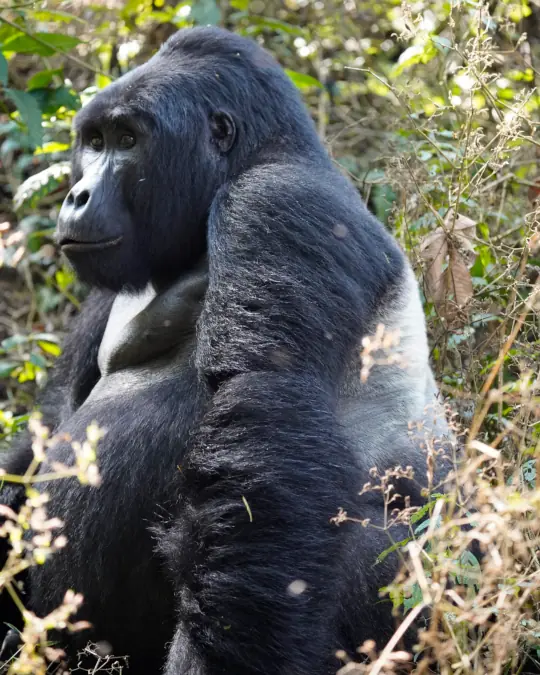
A mountain gorilla is a rare and special primate. This great ape is the least common of the four gorilla subspecies. This ape lives in elevated, wet forests. Its long, dark hair helps keep it warm.
You cannot see this subspecies in zoos. None live in captivity. Seeing them in the wild is a once-in-a-lifetime experience. They only live in the high mountain rainforests of Eastern and Central Africa.
The Eastern gorilla species has two subspecies:
- Gorilla beringei beringei
- Gorilla beringei graueri
Height and weight
Gorillas are the largest and strongest living primates. Adult females weigh around 90 kilograms. Their range is (70–110 kg), and they are about 150 centimeters tall.
Adult males, called silverbacks, are larger. A typical silverback is about 170 centimeters tall and weighs around 155 kilograms.
Conservation of Gorillas
Gorillas face many threats from people. The IUCN Red List lists some gorilla groups as endangered. Governments, groups, and people have created conservation programs. The Dian Fossey Gorilla Fund International is an example.
Many experts believe Eastern gorillas survived in the wild due to Fossey’s work. Her efforts brought the attention of several agencies to the wild.
Why is the mountain gorilla endangered?
If we do not support conservation. These species might become extinct in the wild. Then, gorilla safaris in Africa could come to an end.
Good news! This subspecies is increasing in some areas. This growth is due to ongoing conservation efforts. A notable group is the Virunga Conservation Area.
On a sad note, the eastern lowland gorillas are declining due to human pressure. Their population falls by about five percent each year, which is alarming.
Civil unrest in the Democratic Republic of Congo has caused lawlessness and poaching. People who would protect gorillas often cannot because they must protect themselves.
Where do mountain gorillas live?
They live only in bamboo and montane rainforests. In countries of East and Central Africa. They occupy two separate areas that are about 16 miles apart and are divided by farms and villages.
The first area runs from Bwindi in Uganda to Sarambwe Nature Reserve in eastern DRC.
The second area is the Virunga Conservation Area. The Virunga volcanoes are in Uganda, Rwanda, and the DRC. The parks there include Mgahinga Gorilla National Park (Uganda), Volcanoes National Park (Rwanda), and Virunga National Park (DRC).
How long do gorillas live in their natural habitat?
Gorillas can live for more than 40 years in the wild. You can find them in Bwindi and the Virunga mountain ranges.
What do Mountain gorillas eat daily?
Several plant species forming a gorilla’s diet are in the montane rainforests of Bwindi and Virunga Parks.
Gorillas eat an assortment of green leaves, stalks, shoots, and less fruit. Virunga’s gorillas enjoy thistles, nettles, Galium, and wild celery. Plants have a high water content; hence, very little to no water is taken, depending on the heat levels of the day.
Mountain Gorilla population
The recent joint gorilla census done at the end of 2018 notes that their numbers have surpassed a thousand.
How many mountain gorillas are left in the wild?
The census confirmed that 1,063 of this gorilla subspecies currently live in the wilderness. Another census is ongoing.
Attempts to multiply gorilla populations in zoos have been fruitful. Apart from the gorillas of the mountains. Attempts were in vain, many apes dying defending themselves.
Lowland gorilla subspecies are the only ones living in zoos. This subspecies does not live in captivity. This makes them the rarest and popular for gorilla trekking. Believing is seeing. Book a Uganda safari to see these apes.
Behavior of gorillas
They live in groups that include blackbacks, juveniles, infants, and adult females. The group is headed by a silverback or silverbacks.
More than half of this gorilla species is habituated. Groups have an average family of 4 to 10 family members. Big numbers existed in the Mikeno Sector of Virunga National Park, DRC, in 2022. The Bageni and Wilungula gorilla groups had over 40 family members each. The biggest gorilla group ever recorded had 65 gorillas all in one group living as a family.
Most males and females leave their birth group on reaching maturity. This is to avoid inbreeding. Groups of lonely males exist more often with the mountain gorillas.
Join a group of gorilla trekking tourists in Uganda to learn more.